

Note
Go to the end to download the full example code.
Extract multi-stage cyclic results#
This example uses a multi-stage modal analysis with cyclic symmetry to show how to expand the mesh and results.
Note
This example requires DPF 3.0 (2022 R1) or above. For more information, see PyDPF library compatibilities.
Perform required imports#
Perform required imports. This example uses a supplied file that you can
get by importing the DPF examples package.
from ansys.dpf import post
from ansys.dpf.post import examples
Get Simulation object#
Get the Simulation object that allows access to the result. The Simulation
object must be instantiated with the path for the result file. For example,
"C:/Users/user/my_result.rst" on Windows or "/home/user/my_result.rst"
on Linux.
example_path = examples.download_multi_stage_cyclic_result()
simulation = post.ModalMechanicalSimulation(example_path)

# print the simulation to get an overview of what's available
print(simulation)
Modal Mechanical Simulation.


Data Sources
------------------------------
/opt/hostedtoolcache/Python/3.10.21/x64/lib/python3.10/site-packages/ansys/dpf/core/examples/result_files/multistage/multistage.rst

DPF Model
------------------------------
Modal analysis
Unit system: MKS: m, kg, N, s, V, A, degC
Physics Type: Mechanical
Available results:
     -  node_orientations: Nodal Node Euler Angles
     -  displacement: Nodal Displacement
     -  stress: ElementalNodal Stress
     -  elastic_strain: ElementalNodal Strain
     -  elastic_strain_eqv: ElementalNodal Strain eqv
     -  element_orientations: ElementalNodal Element Euler Angles
     -  structural_temperature: ElementalNodal Structural temperature
------------------------------
DPF  Meshed Region:
  3595 nodes
  1557 elements
  Unit: m
  With solid (3D) elements
------------------------------
DPF  Time/Freq Support:
  Number of sets: 6
Cumulative     Frequency (Hz) LoadStep       Substep        Harmonic index
1              188.385357     1              1              0.000000
2              325.126418     1              2              0.000000
3              595.320548     1              3              0.000000
4              638.189511     1              4              0.000000
5              775.669703     1              5              0.000000
6              928.278013     1              6              0.000000
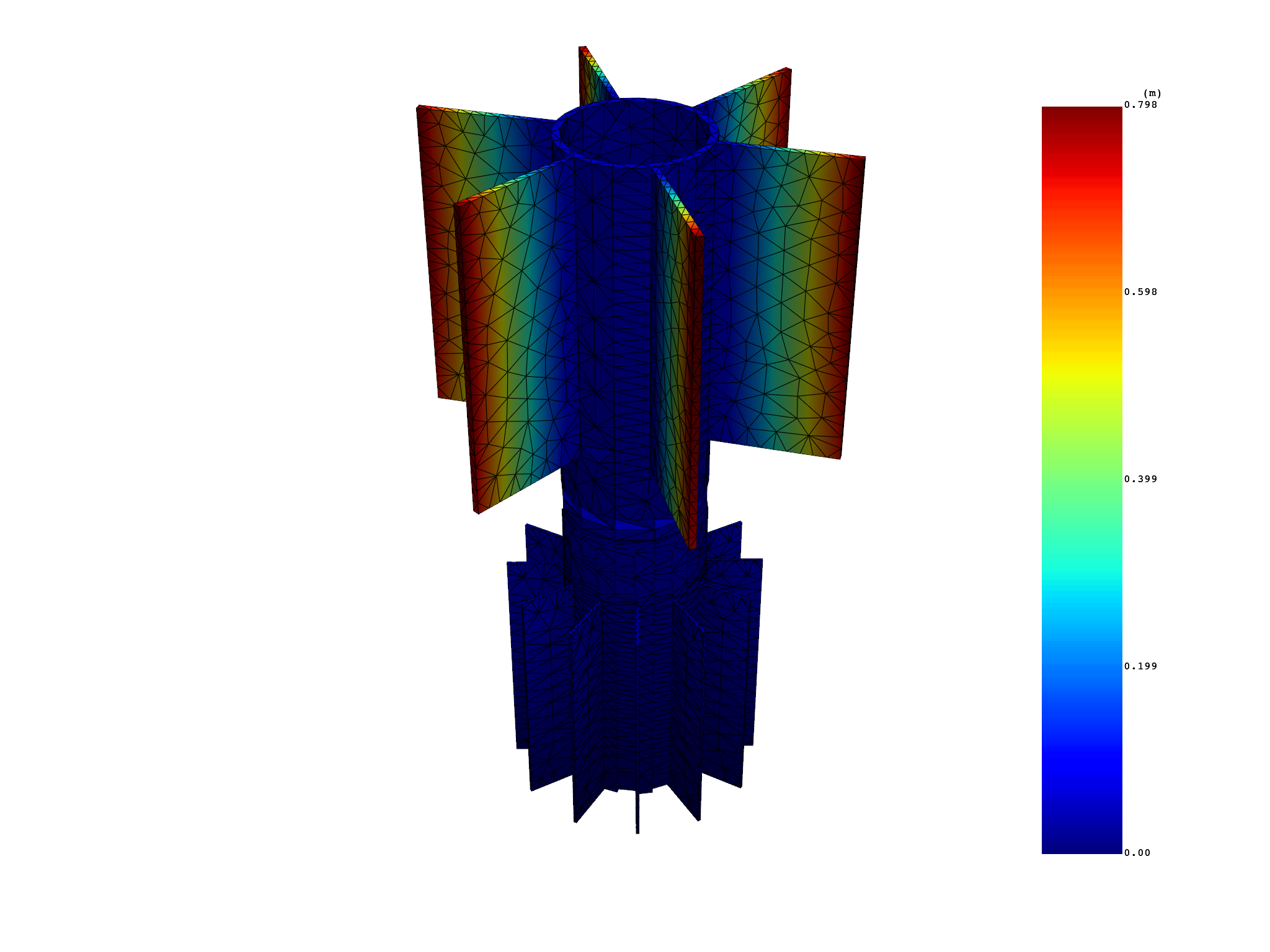
Extract expanded displacement normal#
displacement_norm = simulation.displacement(
    norm=True,
    expand_cyclic=True,
)
print(displacement_norm)
displacement_norm.plot()
  results    U_N (m)
  set_ids          1
 node_ids
     1376 5.2953e-02
     4971 5.2953e-02
     7191 5.2953e-02
     9411 5.2953e-02
    11631 5.2953e-02
    13851 5.2953e-02
      ...        ...


([], <pyvista.plotting.plotter.Plotter object at 0x7fc856628eb0>)
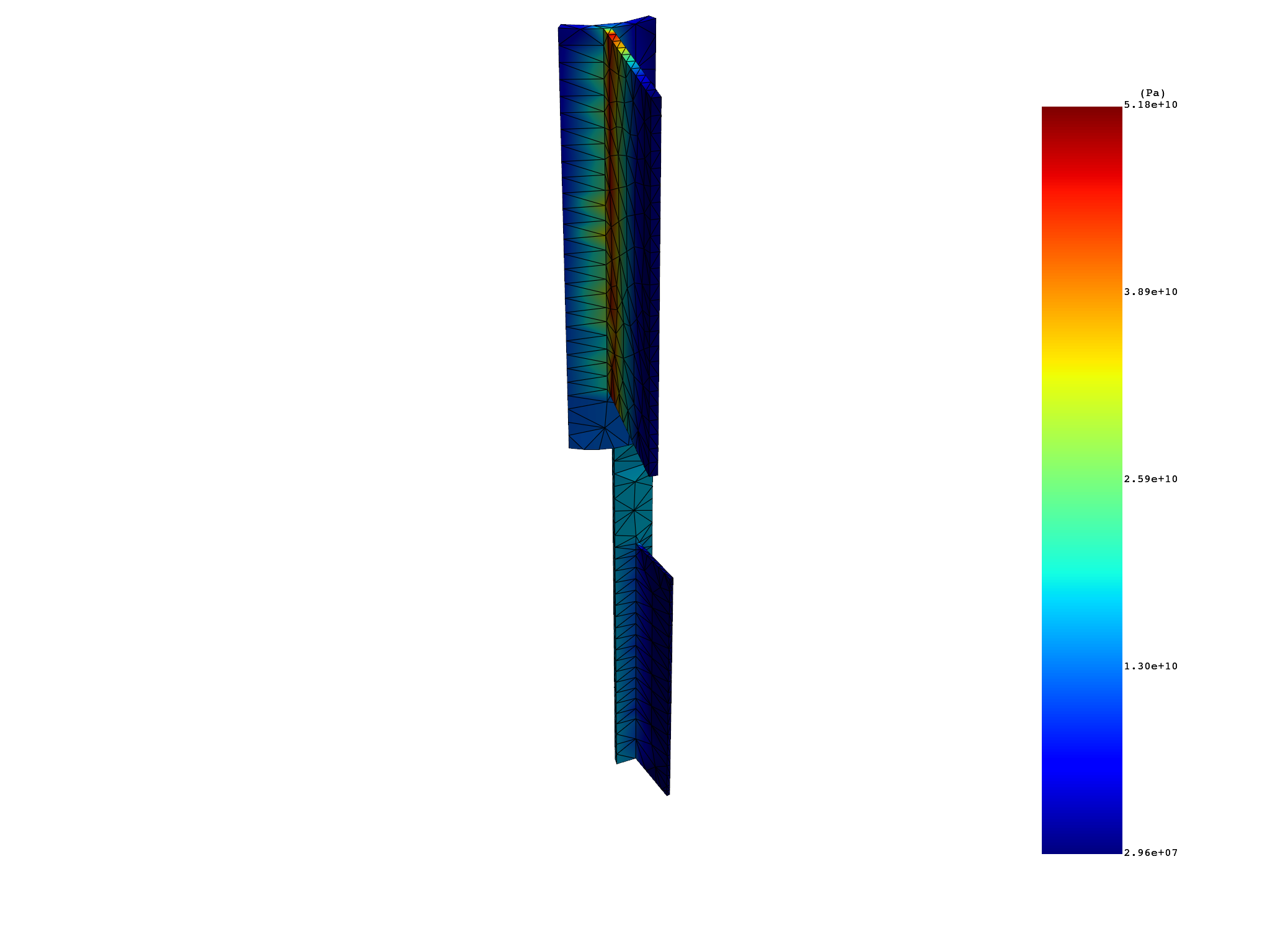
Extract equivalent von Mises nodal stress without expansion#
stress_vm_sector_1_both_stages = simulation.stress_eqv_von_mises_nodal(
    expand_cyclic=False,
)
print(stress_vm_sector_1_both_stages)
stress_vm_sector_1_both_stages.plot()
     results S_VM (Pa)
     set_ids         1
 base_sector         1
       stage         1
    node_ids
        1460
        1622
        1644
        1660
        1490
        1596
         ...       ...


([], <pyvista.plotting.plotter.Plotter object at 0x7fc856366290>)
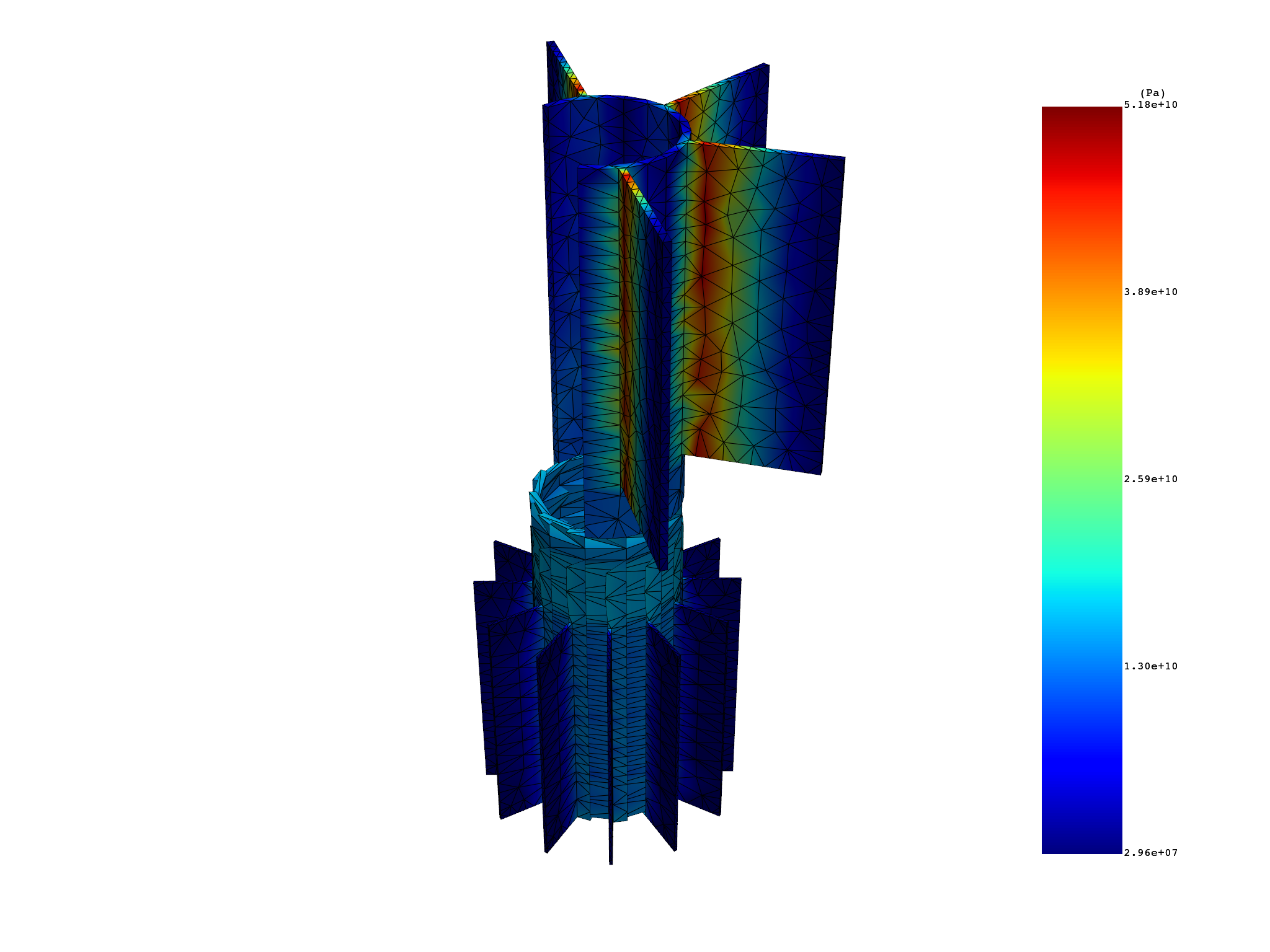
Extract equivalent von Mises nodal stress expanded on first four sectors of first stage#
stress_vm_sectors_1_2_3_4_first_stage = simulation.stress_eqv_von_mises_nodal(
    expand_cyclic=[1, 2, 3, 4],
)
print(stress_vm_sectors_1_2_3_4_first_stage)
stress_vm_sectors_1_2_3_4_first_stage.plot()
  results  S_VM (Pa)
  set_ids          1
 node_ids
     5071 6.2894e+09
     5218 6.9084e+09
     1644 8.0643e+09
     1660 8.5795e+09
     7291 6.2894e+09
     7438 6.9084e+09
      ...        ...


([], <pyvista.plotting.plotter.Plotter object at 0x7fc856367ee0>)
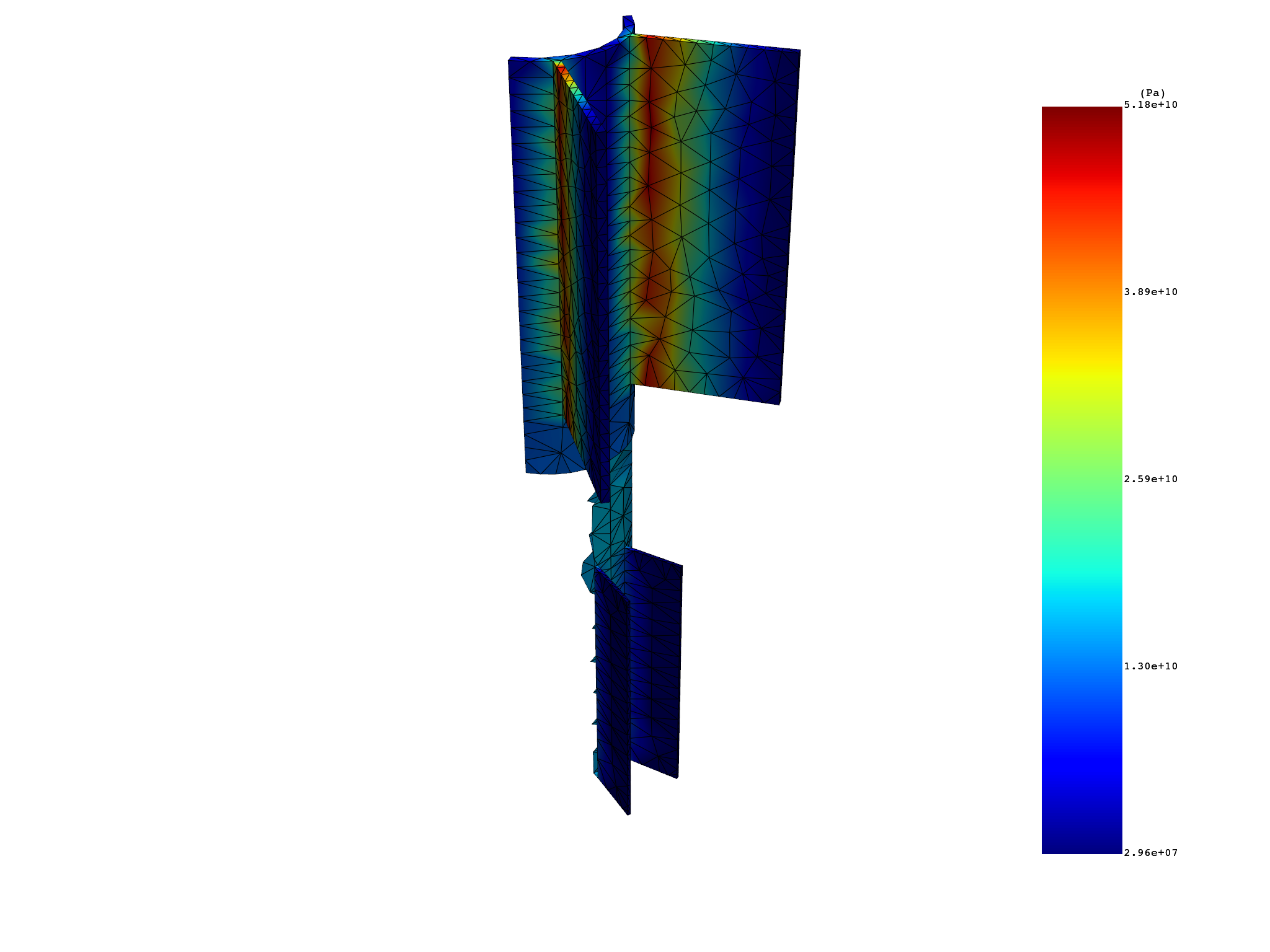
Extract equivalent von Mises nodal stress expanded on first two sectors of both stages#
stress_vm_sectors_1_2_both_stages = simulation.stress_eqv_von_mises_nodal(
    expand_cyclic=[[1, 2], [1, 2]],
)
print(stress_vm_sectors_1_2_both_stages)
stress_vm_sectors_1_2_both_stages.plot()
  results  S_VM (Pa)
  set_ids          1
 node_ids
     5071 6.2894e+09
     5218 6.9084e+09
     1644 8.0643e+09
     1660 8.5795e+09
     7291 6.8763e+09
     7438 7.0456e+09
      ...        ...


([], <pyvista.plotting.plotter.Plotter object at 0x7fc7d0477670>)
Total running time of the script: (0 minutes 2.148 seconds)